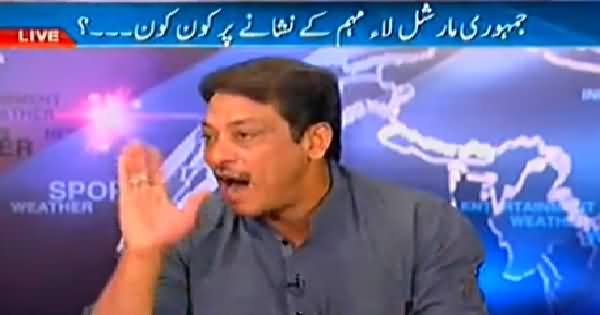
Faisal Raza Abidi towards Jamori Marshal Law

Click to Watch Details about Faisal Raza Abidi's Tehreek-e-nifaz-e-Jhamori Marshal Law.

News Updates

Pakistan, Saudi Arabia sign Dollar 183 million credit agreements.

And the reason why Dollar price comes down in Pakistan. Click For More Details.

Online TV Web Streaming

Click to Watch Online TV Web Streaming. News - Entertainment - Sports...

Showing posts with label technology. Show all posts

Saturday, 22 March 2014

Google enhances encryption technology for email


WASHINGTON: Google says it´s improved the encryption technology for its flagship email service.

The change will make it harder for the National Security Agency to intercept messages moving among the company´s worldwide data centers.

Among the most extraordinary disclosures in documents leaked by former NSA systems analyst Edward Snowden were reports that the NSA had secretly tapped into the main communications links that connect Yahoo and Google data centers around the world.

Google has previously said it was outraged over the practice. It didn´t mention the NSA in Thursday´s announcement, except in a veiled reference to what it called "last summer´s revelations."

Friday, 7 March 2014

In a driverless future, drivers will do anything else


Like usLike usLike usLike usLike usLike usLike usLike usLike usLike usLike usLike usLike usLike usLike usLike usLike usLike usLike usLike usLike us


GENEVA: Brew an espresso, watch a movie on a large screen, surf the Internet or simply sit and chat with friends?


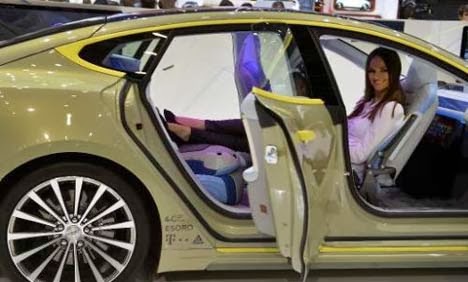
As automakers and technology firms steer towards a future of driverless cars, a Swiss think tank is at the Geneva Motor Show this week showing off its vision of what vehicles might look like on the inside when people no longer have to focus on the road.

"Once I can drive autonomously, would I want to watch while my steering wheel turns happily from left to right?" asked Rinspeed founder and chief executive Frank Rinderknecht.
"No. I would like to do anything else but drive and watch the traffic. Eat, sleep, work, whatever you can imagine," he told AFP at the show, which opens its doors to the public Thursday.
Google is famously working on fully autonomous cars, and traditional carmakers are rapidly developing a range of autonomous technologies as well.
With analysts expecting sales of self-driving, if not completely driverless, cars to begin taking off by the end of this decade, Rinderknecht insists it's time to consider how the experience of riding in a car will could be radically redefined.
Patting his shiny Xchange concept car, Rinderknecht says he envisages a future where car passengers will want to do the same kinds of things we today do to kill time on trains an airplanes.
So Rinspeed has revamped the interior of Tesla's Model S electric car to show carmakers how they might turn standard-sized vehicles into entertainment centres, offices and meeting spots wrapped into one.
The seats can slide, swivel, and tilt into more than 20 positions, allowing passengers to turn to face each other or a 32-inch screen in the back.
Up front too, an entertainment system lines the entire length of the dashboard, and the steering wheel can be shifted to allow passengers a better view of the screens.
And of course there is an espresso machine.
While brewing coffee, video conferencing and keeping an eye on your email at 120 kilometres an hour may sound like a fantasy today, Rinderknecht is convinced it could happen in the not too distanced future.
"We think this is what things could look like in a few years time," he said.
Driving, he said, is on the cusp of being redefined, allowing people to take the wheel for pleasure, for instance while going over an Alpine pass, but handing over control of the car on tedious stretches.
"If I have to go three hours from Geneva to Zurich and it's congested, I'm not doing anything... I want to be doing something else," he said.
Carmakers at the Geneva Motor Show seemed to agree that vehicles that drive themselves, at least to a certain extent, are on the horizon.
"Autonomous driving is an inevitability that we are approaching very rapidly," Hyundai Europe COO Allan Rushforth told AFP.
He stressed though that "full automation" was not a priority.
Ford Europe chief Stephen Odelle also said the technology was speeding forward, but added that he believed "the technology will be ready before legislation and consumers are."
"How comfortable will consumers be with fully automated cars?" he asked, adding that legislating for liability would be quite tricky with no driver behind the wheel.
Rinderknecht acknowledged there are obstacles, but insisted "they can be overcome." He pointed out that accident reduction is actually a major argument for automation, since once the technology is finalised the machines should be far more reliable than humans.
And while it will be an upward battle to redefine liability legislation, "I think it can be done, because laws must adapt to life, and life as we all know changes," he said.

Monday, 24 February 2014

Saudi Arabia 'seeking Pakistani arms for Syrian rebels'


February 24, 2014


DUBAI: Saudi Arabia is in talks with Pakistan to provide anti-aircraft and anti-tank rockets to Syrian rebels to try to tip the balance in the war to overthrow President Bashar al-Assad, a Saudi source said Sunday.


The United States has long opposed arming the rebels with such weapons, fearing they might end up in the hands of extremists, but Syrian opposition figures say the failure of Geneva peace talks seems to have led Washington to soften its opposition.

Pakistan makes its own version of Chinese shoulder-launched anti-aircraft missiles, known as Anza, and anti-tank rockets -- both of which Riyadh is trying to get for the rebels, said the source, who is close to Saudi decision-makers, requesting anonymity.

The source pointed to a visit to Riyadh earlier this month by Pakistan's army chief of staff, General Raheel Sharif, who met Crown Prince Salman bin Abdul Aziz.

Prince Salman himself last week led a large delegation to Pakistan, shortly after Saudi's chief diplomat Prince Saud al-Faisal visited the kingdom's key ally.

Jordan will be providing facilities to store the weapons before they are delivered to rebels within Syria, the same source said.

AFP could not obtain confirmation from officials in Saudi, Pakistan or Jordan.

The head of the Syrian opposition, Ahmad Jarba, promised during a flying visit to northern Syria last week that "powerful arms will be arriving soon."

"The United States could allow their allies provide the rebels with anti-aircraft and anti-tank weapons following the failure of Geneva talks and the renewed tension with Russia," said the head of the Gulf Research Centre, Abdel Aziz al-Sager.

Providing those weapons to the rebels "relieves pressure on the US in the short-term," said Simon Henderson, director of the Gulf and Energy Policy Programme at the Washington Institue for Near East Policy.

"But the long-term political worry is that Manpads (Man-portable air-defence systems) will leak and be used to bring down a civilian airliner somewhere in the world."

Rebels have long said that anti-aircraft rockets would help them defend themselves against Syrian warplanes, which regularly bomb rebel-held areas with barrels loaded with TNT and other ordinance.

The nearly-three-year conflict in Syria has torn the country apart, killing more than 140,000 people, including some 50,000 civilians, according to the Britain-based Syrian Observatory for Human Rights.

Rising Saudi influence

Saudi Arabia has a strong influence on Syria's southern front, where it coordinates with Jordan, and has helped unite the rebel fighters in the area, according to Syrian opposition sources.

On the other hand, Qatar and Turkey are responsible for coordinating with the rebels on the northern front, said an official of the Syrian opposition, requesting anonymity.

Saudi Arabia has come to eclipse Qatar as the main supporter of the Syrian rebels, a development illustrated by the election last July of Ahmad Jarba, who has strong Saudi links, to lead the Syrian National Coalition, the main umbrella opposition group.

The trend appeared to continue with the dismissal last week of General Selim Idriss, the top commander of the Western-backed Free Syrian Army, who was considered close to Qatar, according to an opposition source.

The main criticism of Idriss was "bad distribution of weapons" and "errors in battle," said another opposition source.

Idriss, who has refused his dismissal, has been replaced by Brigadier General Abdel Ilah al-Bashir, the leader of the rebel military council for the region of Quneitra in southern Syria.

On its internal front, Saudi Arabia has sidelined intelligence chief Prince Bandar bin Sultan, who had been leading Riyadh's efforts concerning Syria, according to a Western diplomat.

Diplomats have said that the file has been passed to the interior minister, Prince Mohammed bin Nayef, known for his successful crackdown on Al-Qaeda following a wave of deadly attacks in the kingdom between 2003 and 2006.

Bandar's management had triggered American criticism, diplomats said.

The Saudi royal himself has reproached Washington for its decision not to intervene militarily in Syria, and for preventing its allies from providing rebels with much-needed weapons, diplomats added. (AFP)
Share This On Facebook
Click to Share


Sunday, 23 February 2014

Saudi Arabia will demolish the birthplace of Islam's Prophet Muhammad (peace be upon him)


February 23, 2014


Saudi Arabia will go ahead with plans to demolish the birthplace of Islam’s holy prophet as part of a redevelopment project.


Follow Us at Twitter:

Saudi Arabia will go ahead with plans to demolish the birthplace of Islam’s holy prophet as part of a redevelopment project.
Bulldozers are set to knock down a building in the holy city of Mecca, where Prophet Mohammad (peace be upon him) is believed to have been born.
The demolition of the House of Mawlid is part of a multi-billion-dollar project to build a modern complex near the Masjid al-Haram (Grand Mosque).
The Masjid al-Haram is the holiest Islamic site and houses Kaaba, the point which all Muslims face when praying.
Scholars say the prophet’s birthplace is the last remaining historical site in Saudi Arabia.
The Saudi royal family has backed redevelopment at the cost of razing ancient structures.
The destruction is expected to provoke anger from Muslim pilgrims who travel to Saudi Arabia to perform the Hajj pilgrimage.
In April 2013, Saudi Arabia’s Grand Mufti Sheikh Abdul Aziz Bin Abdullah al-Sheikh defended the demolition of early Islamic heritage sites in Mecca.
The highest Saudi religious authority even went much further and described the demolitions as necessary.


‎أستغفر الله (Astaghfirullah) ‎أستغفر الله (Astaghfirullah)

Click to Play the Video


Other Sources of this news:


News Post
BBC in Urdu

If you Support it then Click on LIKE and Share with others


Saturday, 22 February 2014

Munawar Hassan point on Karbala


February 22, 2014
Pakistani Corrupt Political parties.
Injustice crossing its limits in Pakistan.

War of Karbala Was Between Two Groups of Sehaba and We Don't Know Who Was Right - Munawar Hassan


in a political talk show of Waqt news Mr. Munawar Hassan give his point of view on Karbala.
War of Karbala Was Between Two Groups of Sehaba and We Don't Know Who Was Right - Munawar Hassan

‎أستغفر الله (Astaghfirullah) ‎أستغفر الله (Astaghfirullah)

Click to Play the Video

Share This On Facebook
Click to Share


Friday, 21 February 2014

Facebook to buy WhatsApp for $19 billion


February 21 - 2014

Facebook to buy WhatsApp for $19 billion.


Facebook Inc will buy fast-growing mobile-messaging start up WhatsApp for $19 billion in cash and stock, as the world's largest social network looks for ways to boost its popularity, especially among a younger crowd.

 The acquisition of the hot messaging service with more than 450 million users around the world stunned many Silicon Valley observers with its lofty price tag. But it underscores Facebook's determination to win the market for messaging, an indispensable utility in a mobile era.

Combining text messaging and social networking, messaging apps provide a quick way for smartphone users to trade everything from brief texts to flirtatious pictures to YouTube clips — bypassing the need to pay wireless carriers for messaging services.

And it helps Facebook tap teens who will eschew the mainstream social networks and prefer WhatsApp and rivals such as Line and WeChat, which have exploded in size as mobile messaging takes off. "People are calling them 'Facebook Nevers,'" said Jeremy Liew, a partner at Lightspeed and an early investor in Snapchat.

 WhatsApp is adding about a million users per day, Facebook co-founder and Chief Executive Officer Mark Zuckerberg said on his page on Wednesday. "WhatsApp will complement our existing chat and messaging services to provide new tools for our community," he wrote on his Facebook page. "Since WhatsApp and (Facebook) Messenger serve such different and important users, we will continue investing in both." Smartphone-based messaging apps are now sweeping across North America, Asia and Europe. "Communication is the one thing that you have to use daily, and it has a strong network effect," said Jonathan Teo, an early investor in Snapchat, another red-hot messaging company that flirted year ago with a multibillion dollar acquisition offer from Facebook. "Facebook is more about content and has not yet fully figured out communication." Even so, he balked at the price tag. As part of the deal, WhatsApp co-founder and Chief Executive Officer Jan Koum will join Facebook's board, and the social network will grant an additional $3 billion worth of restricted stock units to WhatsApp's founders, including Koum. That is on top of the $16 billion in cash and stock that Facebook will pay. "Goodness gracious, it's a good deal for WhatsApp," Teo said.

TERMS:

Shares in Facebook slid 5 percent to $64.70 after hours, from a close of $68.06 on the Nasdaq.

Facebook said on Wednesday it will pay $4 billion in cash and about $12 billion in stock in its single largest acquisition, dwarfing the $1 billion it paid for photo-sharing app Instagram.

 The price paid for Instagram, which with just 30 million users was already considered overvalued by many observers at the time.

 Facebook promised to keep the WhatsApp brand and service, and pledged a $1 billion cash break-up fee if the deal falls through. Facebook was advised by Allen & Co, while WhatsApp has enlisted Morgan Stanley for the deal.

Media and News Network


Share This On Facebook
Click to Share

Thursday, 20 February 2014

Reality of PML.N and some Pakistani media who support India's mission.


Pakistani Corrupt Political parties. Injustice by Pakistan Muslim league expose by Mubashar Luqman in his Program on ARY News 20 February 2014.
Injustice crossing its limits in Pakistan.


Shame on you Muslim league (nawaz group), GEO news and TTP (Terrorists).

Click to Play the Video

Share This On Facebook
Click to Share


Pakistan is an agricultural country and 70% of its population is directly or indirectly dependent on agriculture. The sector is facing problems like no effective measures have been taken to curb water wastage, power outages, old methods of cultivation and harvesting and no emphasis on the importance of solving the problems of farmers etc. As most of the farmers are illiterate, poor and unaware, they need proper trainings. They are installing more and more tube wells on self-help efforts to irrigate their crops. Since lack of guidance and advance techniques of farming is the main reason of farmer’s backwardness. In order to meet the needs of the growing population, modern agricultural technologies must be used to increase crop yields.

When stars explode, it´s a messy business


February 20 - 2014

WASHINGTON: When stars explode, it´s a messy business. But the massive blasts are also useful, seeding the universe with such key elements as calcium, iron and titanium.


And with the help of a new high-energy X-ray telescope, NASA said Wednesday astronomers are closer than ever to seeing just what´s going on. "This is helping us untangle the mystery surrounding how stars explode," said Fiona Harrison, principal investigator on NuSTAR, or the Nuclear Spectroscopic Telescope Array. Combined with images from another NASA X-ray observatory, Chandra, NuSTAR has created the "first ever map of radioactive material in the remnants of a star that exploded," she told reporters. One of the biggest surprises was that stars, which are spherical objects, do not explode in a circular manner, she said. Rather, it appears that the blast is more lumpy and distorted from the very beginning. "Prior to the explosion, the core of the star literally sloshed about," said Harrison, a scientist at the California Institute of Technology. Astronomers based their findings on the observations of Cassiopeia A, or Cas A for short, a remnant of a supernova 11,000 light years away. The star exploded around 350 years ago, blowing off outer layers with an extreme heat that created even more elements. Cas A has been expanding since the year 1670, propelling debris at a speed of 10 million miles an hour, but never before have scientists been able to glimpse the radioactivity that was produced inside the explosion. "With NuSTAR, we have a new forensic tool to investigate the ashes left behind when this star exploded," said Brian Grefenstette, an astronomer at Caltech. NuSTAR launched in 2012 on a two-year mission, joining the NASA fleet that also includes the Hubble Space Telescope. It is the first orbiting telescope to focus on the high-energy X-rays of the electromagnetic spectrum. Although the Chandra Observatory remains the world´s most powerful X-ray telescope, NuSTAR can monitor a range the older orbiting telescope can´t see. Robert Kirshner, an astronomer at the Harvard-Smithsonian Center for Astrophysics, described the radioactivity map NuSTAR produced as "pioneering science." "You should care about this," said Kirshner, who was not involved in the project."Stars perform a kind of alchemy where they turn one element into another," he said. "The Earth itself is something that is the residue of this astronomical process," said Kirschner. Star explosions played a key role in the iron used to make cars, the calcium in our bones and the titanium used to manufacture hip replacements, he explained. "So we are all star dust and NuSTAR is showing us where we came from, including our replacement parts.

Media and News Network


Share This On Facebook
Click to Share